
What happens to energy during gas molecule collisions?
Collision is perfectly elastic; when two molecules collide, they change direction and kinetic energy, but the total kinetic energy is conserved. Collision is not « sticky ». The average kinetic energy of gas molecules is proportional to the absolute temperature.
What happens when gas molecules collide?
The gas particles are in a constant state of random motion and move in a straight line until they collide with another object. The collisions exhibited by gas particles are perfectly elastic; when two molecules collide, Conservation of total kinetic energy.
What happens to the energy when gas particles collide?
kinetic energy During an elastic collision, there may be a transfer from one particle to another, but the total energy of the colliding particles does not change. There are no attractive or repulsive forces between gas particles.
Do molecules lose energy when they collide?
All collisions between gas molecules are perfectly elastic; all kinetic energy is conserved. When a car crashes, energy is lost by bending bumpers and metal. Molecules are not like this. Instead, they are like billiards.
Do gas particles lose most of their energy during collisions?
Gas particles are constantly colliding with each other and their container walls. These collisions are elastic; that is, Collision has no net loss of energy. The gas particles are so small that the total volume occupied by the gas molecules is negligible relative to the total volume of the container.
collision theory
20 related questions found
What causes gas molecules to move more slowly?
Because all gases are the same Average kinetic energy at the same temperature, on average, lighter molecules move faster and heavier molecules move slower. Molecular Dynamics Theory of Gases (continued)). It is close to (but not identical to) the average velocity of the molecules.
Which of the following gas molecules has the longest mean free path?
so hydrogen has the smallest molar mass, so it has the largest mean free path.
Do real gases lose kinetic energy?
Gas particles are in continuous, random motion. Collisions between gas particles are completely elastic. in other words, No net loss or gain The kinetic energy of the particles when they collide. The average kinetic energy of all gases at a given temperature is the same, regardless of the gas’s identity.
When the gas is ideal, no energy is lost during the collision?
The particles of an ideal gas have no attraction to each other or to their surroundings. Thus, the collisions exhibited by gas particles are perfectly elastic; when two molecules collide, the total kinetic energy is conserved. Question 8 (1 point) When the gas is an ideal gas, no energy is lost during the collision.
At what temperature do molecules have no energy and stop moving?
exist Zero Kelvin (minus 273 degrees Celsius) The particles stop moving and all the chaos disappears. So on the Kelvin scale, nothing is colder than absolute zero.
What determines the average kinetic energy of any gas molecule?
The average kinetic energy of the particles in the gas is proportional to gas temperature…if they were moving faster, the particles would apply more force to the container each time they hit the wall, causing the gas pressure to increase.
When a gas particle hits a wall, what is it called?
Kinetic molecular theory can be used to explain each experimentally determined gas law. The connection between P and n. The pressure of the gas is created by collisions between the gas particles and the walls of the container. Every time a gas particle hits a wall, a force is applied to the wall.
What happens to gas particles when gas is compressed?
Gases are compressible because most of their volume is made up of a lot of empty space between gas particles. …when the gas is compressed, such as when a scuba cylinder is filled, Gas particles are forced closer together.
What is the ability of gas molecules to diffuse rapidly?
Gaseous particles are in constant random motion.Gaseous particles tend to diffuse because they have kinetic energy. Diffusion is faster at higher temperatures because the gas molecules have more kinetic energy. Bleeding refers to the movement of gas particles through small pores.
Does temperature affect the kinetic energy of gas molecules?
According to kinetic molecular theory, An increase in temperature increases the average kinetic energy of the molecules. As the particles move faster, they may hit the container edge more frequently. …increasing the kinetic energy of the particles increases the pressure of the gas.
What happens when ideal gas particles collide?
The gas particles are in a constant state of random motion and move in a straight line until they collide with another object. The collisions exhibited by gas particles are perfectly elastic; when two molecules collide, Conservation of total kinetic energy.
Which of the following is true about Boyle’s Law?
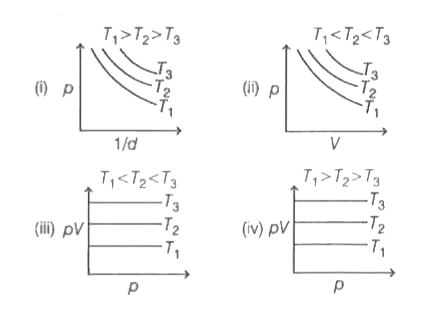 Therefore, Figures (ii) and (iii) are correct.Therefore, the option (d) is the correct answer.
What does the internal energy of an ideal gas depend on?
The internal energy and enthalpy of an ideal gas depend only on temperature, not volume or pressure…by applying the property relationship, it is proved that the internal energy and enthalpy of an ideal gas are independent of volume and pressure, respectively.
Do ideal gases obey isothermal changes?
Isothermal expansion will continue as long as the applied force is reduced and appropriate heat is added to maintain the pV = 2. Expansion is said to be internally reversible if the piston moves slowly enough so that the gas temperature and pressure are uniform at each instant and obey the ideal gas law.
What are the five assumptions of an ideal gas?
The ideal gas law assumes that gases behave ideally, which means that they obey the following characteristics: (1) the collisions that occur between molecules are elastic and their motion is frictionless, which means that the molecules do not lose energy; (2) The total volume of a single molecule is smaller …
What do gas molecules do when they lose energy?
condensation Occurs when molecules in a gas cool. When molecules lose heat, they lose energy and slow down. They are closer to other gas molecules. Eventually these molecules clump together to form a liquid.
What are the 5 assumptions of the kinetic theory of gases?
The five main postulates of the Kuomintang are as follows: (1) The particles in the gas are in constant, random motion(2) the total volume of the particles is negligible, (3) no force is applied between the particles, (4) any collisions between the particles are completely elastic, (5) …
Which gas has the maximum mean free path?
The mean free path is the average distance traveled by a molecule between two consecutive collisions. Obviously, molecules with smaller molecular size will have larger mean free path. Therefore, the correct choice is (a), H2.
What is the mean free path of a molecule?
The mean free path is Average distance traveled by moving molecules between collisions.
What is the maximum value of the mean free path?
Small molecule has the largest mean free path.